“Are we behind on AI?”
It is a question many business leaders are quietly asking.
With constant updates about automation, machine learning, and generative AI, it can feel like your company is missing out. But here is the truth. Most businesses are not truly behind. They are simply at different stages of AI maturity.
The real challenge is not access to AI tools. It is understanding how to use them to create real business value.
In this guide, you will learn:
- How to assess how far behind your company really is on AI
- The different stages of AI adoption in B2B
- The hidden gaps that slow down progress
- Practical steps to move forward with confidence
What Does “Behind on AI” Actually Mean?
Being behind on AI does not mean you are not using AI tools. It means your company is not yet turning AI into measurable results.
A Simple Analogy
Think of AI like electricity in its early days:
- Some companies used it just for lighting
- Others powered entire factories
Both used electricity, but only one transformed its business. The same applies to AI. The difference is not usage. It is maturity.
The Real AI Gap: What Are You Missing?
Before measuring progress, it helps to understand where gaps usually exist. Most companies face one or more of these three gaps:
1. Infrastructure Gap (The Data Problem)
AI needs clean, connected data to work. If your data is spread across spreadsheets, stored in disconnected systems, or hard to access and inconsistent, then the issue is not AI. It is your data foundation.
2. Adoption Gap (The Usage Problem)
Sometimes companies have access to AI tools, but teams are not using them effectively.
Signs include:
- Employees doing manual work that AI could automate
- Low usage of available tools
- Lack of training or awareness
This gap is about people, not technology.
3. Innovation Gap (The Strategy Problem)
This is the most critical gap. It happens when companies use AI only for small efficiency gains and fail to rethink how they operate or deliver value. In simple terms, they improve tasks but do not transform the business.
The AI Maturity Levels: Where Does Your Company Stand?
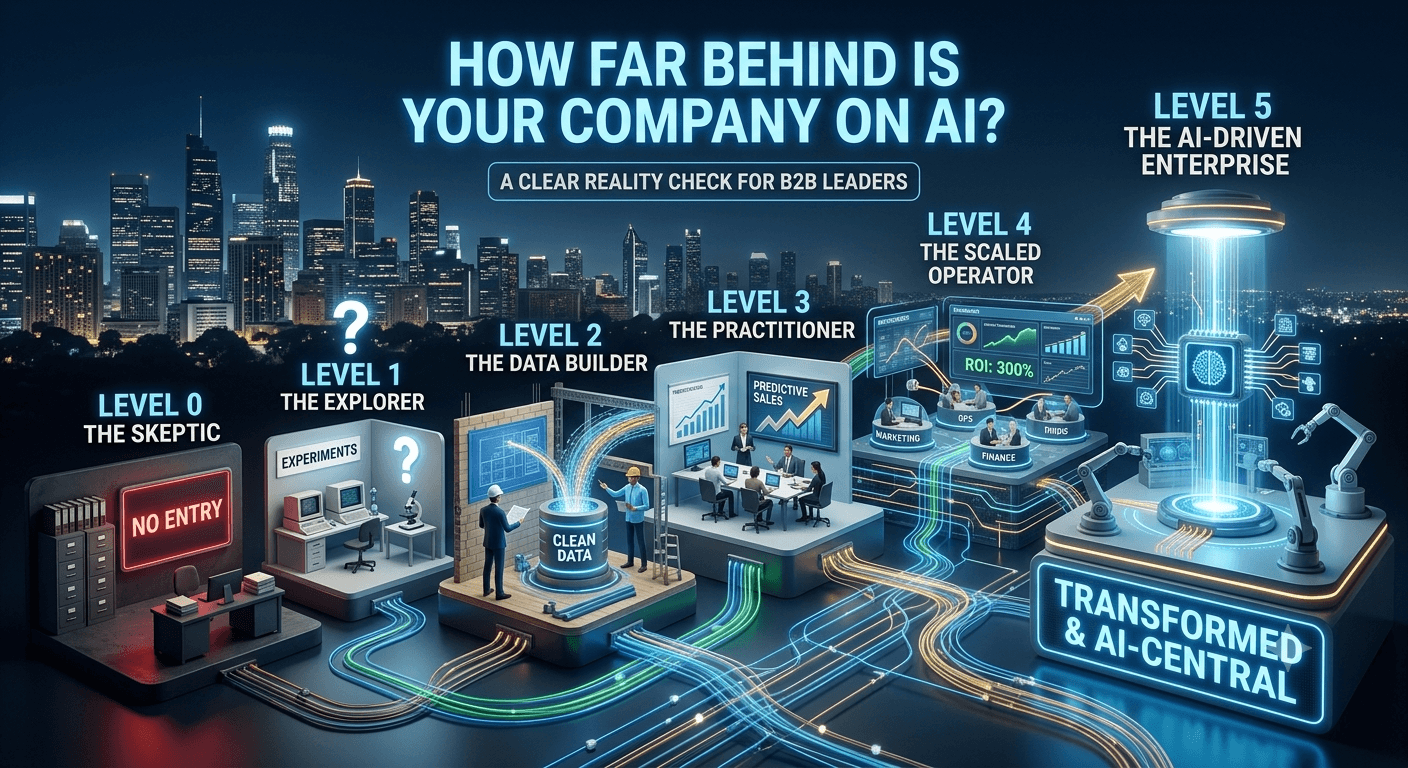
To understand how far behind you are, you need a clear benchmark. Most B2B companies fall into one of these levels:
- Level 0: The Skeptic: AI is seen as a trend or risk. No clear investment or policy. Usage may be limited or unofficial.
- Level 1: The Explorer: Teams experiment with AI tools. No structured strategy. Data is still fragmented.
- Level 2: The Data Builder: Data is being organized and centralized. Basic systems and policies are introduced. AI use is becoming intentional.
- Level 3: The Practitioner: AI is used in specific business functions. Predictive insights are introduced. Early ROI is visible.
- Level 4: The Scaled Operator: AI is integrated across departments. Decisions are supported by data. ROI is consistent and measurable.
- Level 5: The AI-Driven Enterprise: AI is central to business strategy. Systems continuously learn and improve. Decisions are automated or AI-assisted.
7 Signs Your Company Might Be Behind on AI
Instead of guessing, look for these signals inside your organization: 1. Data is messy and disconnected 2. AI is treated as a side project 3. No clear AI strategy from leadership 4. Low adoption among employees 5. Decisions rely mostly on intuition 6. No measurable ROI from AI initiatives 7. Resistance or fear around AI usage
If you recognize several of these, your company likely has an AI maturity gap.
Why Most Companies Feel Behind (But Aren’t)
The feeling of being behind often comes from perception, not reality.
Common reasons:
- Comparing with tech giants: Large companies have more resources and data.
- Hype vs reality gap: AI is often presented as more advanced than it is in practice.
- Hidden complexity: The real work lies in data, processes, and culture.
Insight: Feeling behind often means you are becoming aware. That is the first step toward progress.
The Hidden Advantage of Starting Late
There is a surprising upside to not being first. Early adopters of AI often invested heavily in tools that became outdated or built systems that were expensive to maintain.
By starting now, you can learn from their mistakes, use more mature and cost-effective tools, and focus directly on proven use cases. This is known as the second-mover advantage.
How to Catch Up Without Overwhelming Your Team
You do not need a massive transformation overnight. Focus on practical, steady progress.
Step 1: Start with Business Problems
Ask:
- Where are we losing time?
- What processes are repetitive?
- Where can better decisions improve outcomes?
Step 2: Fix Your Data Foundation
Focus on:
- Clean and structured data
- Centralized systems
- Consistent reporting
Step 3: Target High-Impact Use Cases
Start small with areas like:
- Lead scoring
- Customer churn prediction
- Demand forecasting
Step 4: Enable Your Teams
Build basic AI awareness:
- What AI can do
- How to use tools safely
- When to trust AI outputs
Step 5: Create Clear Guardrails
Define:
- What data can be used with AI tools
- Security and privacy rules
- Approved tools and workflows
This reduces fear and increases adoption.
Step 6: Measure and Scale
Track cost savings, revenue improvements, and efficiency gains. Then expand successful use cases across departments.
A Better Question to Ask
Instead of asking “How far behind are we?”, ask “What is the next smartest step forward?” AI maturity is not a race. It is a continuous journey.
Common Mistakes That Slow Down Progress
- Jumping into AI without fixing data
- Trying to automate everything at once
- Ignoring employee training
- Expecting instant results
- Treating AI as only a technical initiative
What “On Track” Looks Like in the Future
Companies that are progressing well with AI will use AI in everyday decision-making, automate repetitive workflows, and personalize customer experiences. You do not need to be perfect. You just need to keep moving forward.
Conclusion
So, how far behind is your company on AI? Probably less than you think. The real difference comes from clarity, consistency, and action.
Organizations that succeed with AI are not always the fastest; they are the most consistent.
Now ask yourself: What is the next step your company can take today?