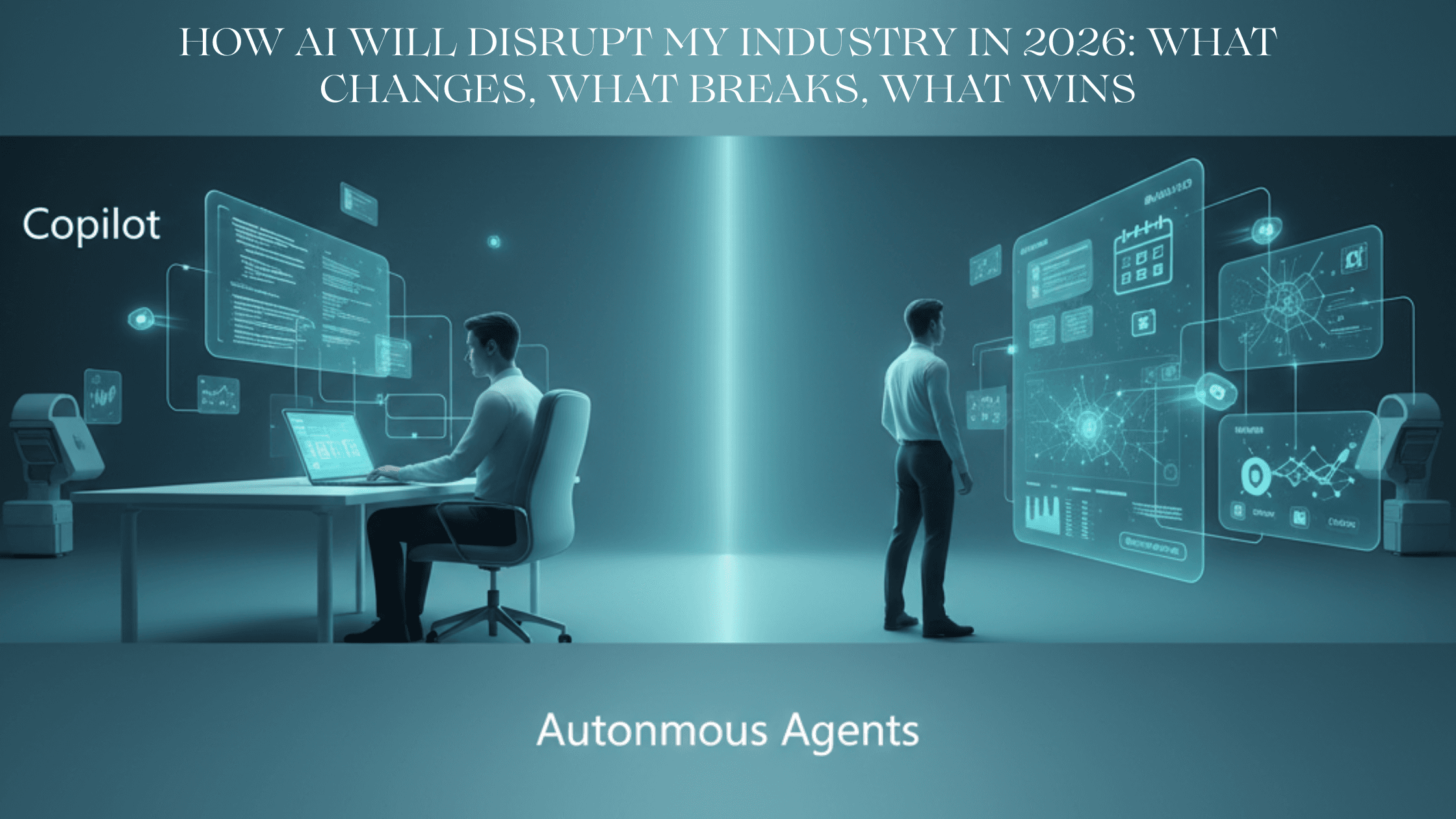
2026 Is Not the Future. It Is the Deadline
Imagine adding a new team member who never sleeps, learns from every mistake, predicts problems before they happen, and costs less than your monthly software stack. That is not a futuristic scenario. That is artificial intelligence in 2026.
Across industries, leaders are no longer debating whether AI will disrupt their field. That question is already settled. The real concern now is how fast the disruption will happen and who will be ready when it does.
By 2026, AI will move from being a helpful assistant to an active decision maker and executor. This article explains how AI will disrupt industries in 2026, what will fundamentally change, what will quietly break, and what will clearly win. More importantly, it shows how professionals and businesses can stay relevant as this shift accelerates.
The Big Shift: From Tools to Decision Makers
For most of the past decade, AI has been treated as a tool. It helped analyze data, automate reports, or answer questions faster. In 2026, that model breaks.
AI becomes a decision support engine and, in many cases, a decision executor.
Instead of only providing insights, AI systems will analyze massive datasets in real time, recommend specific actions, and execute predefined decisions autonomously. Pricing updates, staffing forecasts, inventory planning, customer responses, and risk alerts will increasingly happen without waiting for human approval.
Think of AI evolving from a calculator into a co pilot, and now into a driver that can take the wheel under defined rules. This shift will impact manufacturing, healthcare, finance, education, IT services, marketing, and nearly every knowledge based industry.
AI driven decision making will be one of the defining forces of AI disruption in 2026.
Automation 2.0: Tasks Disappear, Not People
Much of the fear around AI comes from job loss. In reality, the disruption is more precise.
AI automation in 2026 focuses on eliminating repetitive tasks, not entire roles.
AI will increasingly take over data entry, rule based approvals, first level customer support, routine analysis, and standard reporting. Instead of humans checking thousands of records, AI will surface only the exceptions that need judgment.
If early automation was like a conveyor belt, AI automation is closer to a self driving factory. Processes adapt, optimize, and correct themselves in real time.
The result is faster execution, fewer bottlenecks, and human teams spending more time on complex problem solving, creativity, and strategy.
The Rise of Agentic AI: From Assist to Execute
The biggest leap in 2026 is the shift from assistive AI to agentic AI.
In recent years, AI tools required constant human prompting. You asked, it responded. You guided, it assisted. That phase is ending.
Agentic AI systems have agency. They can plan multi step tasks, use external tools, coordinate across systems, and complete workflows independently.
A useful analogy is this. Earlier AI behaved like a talented intern who needed detailed instructions. Agentic AI behaves like a mid level manager who is given a goal and figures out how to achieve it.
For example, instead of asking AI to generate marketing copy step by step, you can set an objective such as increasing event registrations. The AI agent can plan campaigns, allocate budgets, coordinate channels, track results, and optimize in real time.
This delegation shift is at the heart of AI industry disruption in 2026.
Industry Specific AI Replaces One Size Fits All Models
Generic AI models are powerful, but they are not enough for high risk or high precision industries. By 2026, industry specific AI solutions will dominate.
These domain trained models understand sector language, regulations, workflows, and context. They reduce errors, improve accuracy, and build trust.
In healthcare, AI assists with diagnosis prioritization and treatment planning. In manufacturing, AI predicts equipment failure and optimizes production. In education, AI personalizes learning paths based on student behavior. In finance, AI models risk, compliance, and cash flow with unprecedented depth.
Domain specific language models also reduce hallucinations, making AI outputs more reliable for professional use. This specialization will clearly separate leaders from laggards.
Industry Snapshots: What Disruption Looks Like on the Ground
Healthcare: From Support to Clinical Twins
Healthcare AI moves beyond documentation and diagnostics. By 2026, digital twins of patients will be used to simulate treatments before they are applied in real life. AI systems will handle follow ups, appointment scheduling, prescription routing, and wearable data monitoring, alerting doctors before health events occur.
Finance: Emotion and Prediction
Finance shifts from fast to perceptive. Emotion AI detects stress or urgency in customer interactions and adapts responses accordingly. AI powered data fabrics allow near real time forecasting of cash flow, risk exposure, and market shifts with extreme accuracy.
Manufacturing: Self Healing and Micro Factories
Manufacturing embraces agentic systems that order replacement parts, schedule downtime, reroute production, and balance supply chains automatically. AI enables smaller, hyper local micro factories that support mass customization while reducing shipping costs and emissions.
Data Becomes the Operations Layer
By 2026, data is no longer something businesses analyze after the fact. It becomes the operating system.
AI systems continuously learn from customer behavior, operational performance, and market changes. Prices adjust dynamically. Supply chains reroute before disruptions hit. Marketing campaigns optimize while still running.
Organizations that treat data as static will fall behind. Those that treat it as a living system will gain speed, resilience, and advantage.
Jobs Will Change. Skills Will Shift.
AI disruption in 2026 does not eliminate human value. It redefines it.
Roles built around repetitive decisions, manual data handling, and fixed processes will shrink. Roles that emphasize creativity, strategic thinking, emotional intelligence, and oversight will grow.
New job categories are already emerging, including AI workflow managers, prompt strategists, AI auditors, and ethics and compliance leads.
One critical skill will stand out: AI orchestration. Professionals will need to manage teams of AI agents, ensuring alignment, accuracy, and accountability. Success will come from knowing how to guide machines, not compete with them.
Trust, Ethics, and Governance Take Center Stage
As AI gains autonomy, trust becomes essential.
Industries will face hard questions around bias, transparency, data privacy, and accountability. Explainable AI will be mandatory, especially in regulated sectors such as healthcare, finance, and education.
Governance shifts from simply protecting data to managing autonomous behavior. Clear rules, audit trails, and human oversight will define responsible AI adoption.
What Will Win in 2026 and What Will Break
Winning organizations will redesign workflows around AI instead of adding it as an afterthought. They will invest in AI literacy across teams, combine human judgment with machine intelligence, and experiment early.
Losing organizations will treat AI only as a cost cutting tool, ignore skill transitions, and react too late to structural change.
The difference will not be access to technology. It is mindset and readiness.
Final Thought: AI Is Not the Threat. Inaction Is.
By 2026, AI will not arrive with dramatic announcements. It will quietly reshape how industries operate, decide, and compete. The biggest disruption will not come from machines replacing humans, but from organizations that fail to adapt while others accelerate.
The real question is no longer how AI will disrupt your industry in 2026.
It is what role you will play when it does.
The deadline is closer than it looks.