Introduction: A New David vs Goliath Story
For decades, size meant stability in business. Large companies with massive budgets, global teams, and strong brand recognition held a powerful advantage. But today, the competitive landscape is changing.
A new wave of AI-native startups competing with established companies is proving that intelligence and adaptability matter more than sheer scale. These startups are built around artificial intelligence from the beginning, allowing them to move faster, innovate quicker, and respond to customer needs almost instantly.
This shift is not just another technology upgrade. It represents a completely new way of building companies, products, and competitive strategies.
What Does AI-Native Actually Mean?
An AI-native company is not simply a business that uses artificial intelligence tools. Instead, AI is the foundation of how the company operates.
To understand the difference, consider two approaches.
AI-enabled companies add AI features to existing products. For example, a traditional software platform might add AI chat assistance or automation to improve existing workflows.
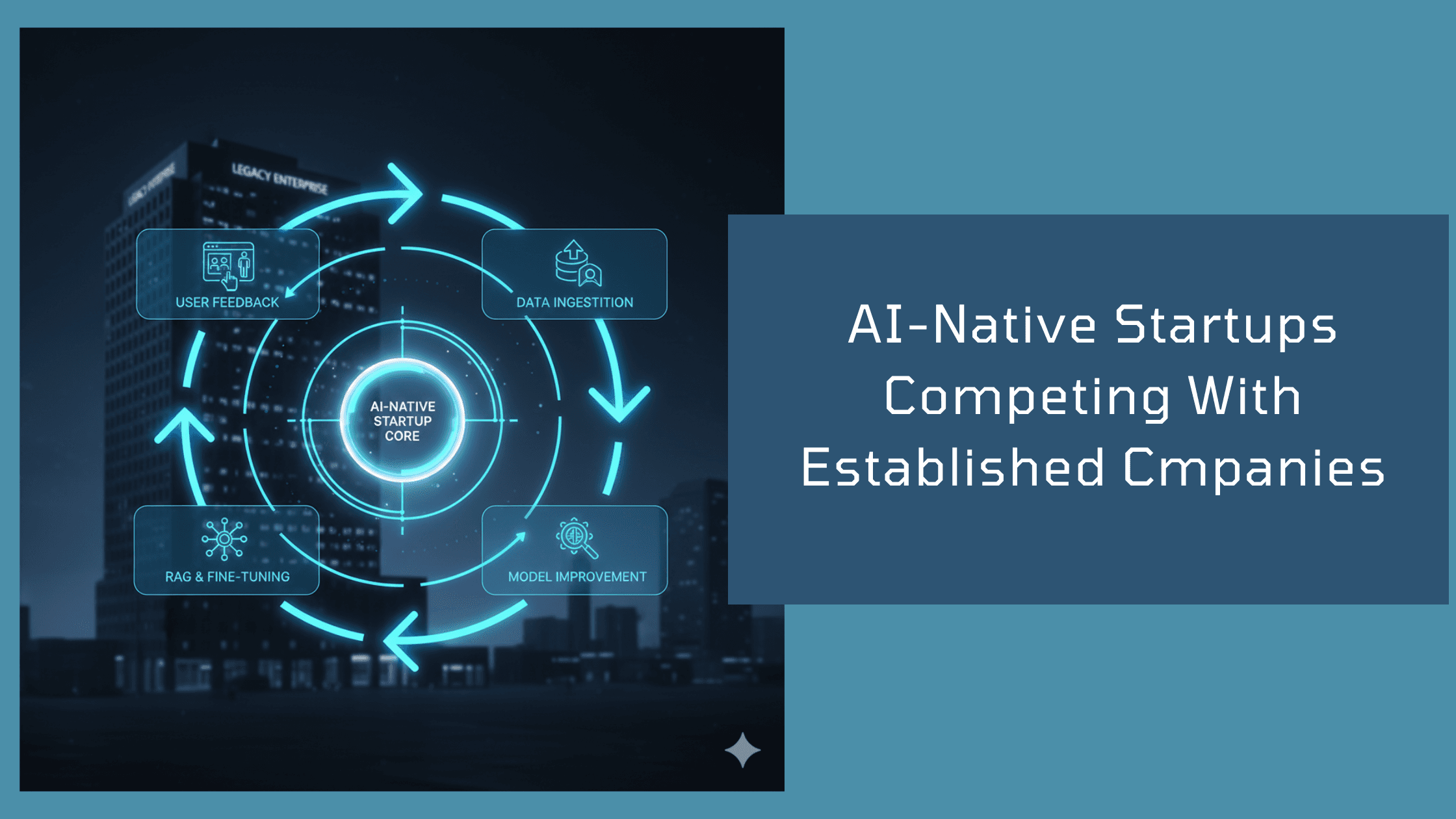
AI-native startups, however, build their entire system around AI from day one. Their products are designed so that data constantly flows into AI models, which learn and improve automatically as more users interact with the system.
In an AI-native architecture, software evolves continuously. AI helps make decisions, automate processes, and enhance the product experience without requiring major manual updates.
This AI-first approach allows startups to innovate much faster than companies trying to retrofit AI into older systems.
Why AI-Native Startups Move Faster
Many established companies struggle to adapt quickly to AI innovation. The challenge is not a lack of talent or resources. Instead, the issue is legacy systems and complex internal processes.
AI-native startups benefit from several structural advantages.
Lean Teams
Most AI startups operate with small teams of specialists, often between 10 and 30 people. With fewer layers of management and faster communication, decisions can happen quickly.
No Legacy Technology
Large companies often rely on decades-old codebases and infrastructure. Integrating AI into these systems can be slow and complicated.
Startups begin with a clean slate. Their technology stack is designed specifically for AI models and modern data systems.
Faster Iteration
Instead of yearly product releases, AI-native startups can update features weekly or even daily. Continuous data feedback improves the system with every user interaction.
A useful analogy is transportation. Established companies operate like cargo ships. They are powerful but slow to change direction. AI-native startups act more like speedboats that can quickly adjust course when new opportunities appear.
How AI Changes the Economics of Competition
Artificial intelligence is dramatically reducing the cost of building and scaling software companies.
Tasks that once required entire teams can now be automated using AI systems. Examples include:
- Code generation and testing
- Customer support through AI agents
- Data analysis and forecasting
- Marketing optimization and content creation
Because of this automation, startups can build products faster and operate with significantly lower costs. They can also scale their business without hiring large numbers of employees.
For established companies, matching this efficiency often requires large organizational changes, which can be difficult and time consuming.
The Data Loop Advantage
In the world of AI, data plays a critical role. AI-native startups often build products that create powerful feedback loops.
Every interaction with users generates new data. That data is analyzed and fed back into the AI models, improving performance over time. This continuous learning cycle allows the product to evolve rapidly.
Techniques such as reinforcement learning from human feedback help models adapt to real-world usage. Over time, this creates a valuable knowledge base that competitors may struggle to replicate.
This data loop advantage becomes one of the most powerful competitive moats for AI-native companies.
Focus and Vertical Expertise
Another major strength of AI startups is their ability to focus on narrow, high-value problems.
Instead of building broad platforms that serve everyone, many startups target specific industries or workflows.
For example, some companies build AI tools specifically for:
- Legal contract analysis
- Pharmaceutical research
- Enterprise sales automation
- Marketing copy generation
By focusing on a single domain, startups can train specialized models using carefully curated data. These vertical models often outperform general purpose AI systems used by larger platforms.
This strategy allows startups to deliver extremely high value in a specific area, making them strong competitors to established software providers.
Where the Competition Is Happening
The rivalry between startups and incumbents is visible across multiple industries.
Enterprise Software
Traditional enterprise tools like CRM and ERP platforms often involve complex manual processes.
AI-native startups are redesigning workflows so that AI performs many tasks automatically. For example, AI sales tools can transcribe calls, summarize conversations, and suggest follow up actions without manual input.
Content and Media Creation
Generative AI has dramatically changed how content is created. Startups are building tools that generate marketing copy, images, video, and even software code.
These platforms allow individuals and small teams to produce high quality content much faster than traditional methods.
Search and Knowledge Retrieval
Search technology is also evolving. Instead of returning a list of links, AI systems increasingly provide direct answers, summaries, and insights.
Startups experimenting with retrieval augmented generation and vector databases are redefining how users interact with information online.
How Established Companies Are Responding
Despite the rise of AI startups, large companies still have significant advantages.
They possess massive user bases, established distribution channels, and substantial financial resources. These strengths allow them to respond in several ways.
- Building Internal AI Teams: Many established companies are investing heavily in AI research and development to upgrade their existing products.
- Acquiring Startups: When a promising AI startup gains traction, large companies often acquire it to integrate the technology into their ecosystem.
- Rebuilding Core Products: Some incumbents are redesigning their platforms using AI-first architecture rather than simply adding AI features on top of existing systems.
However, cultural challenges can slow down these efforts. Large organizations are often optimized for stability and risk reduction, while AI innovation rewards experimentation and rapid iteration.
Who Is Likely to Win?
The future will not simply be startups replacing established companies.
Instead, the winners will likely fall into two groups: 1. AI-native startups that create entirely new product categories will continue to disrupt traditional markets. 2. Established companies that successfully redesign their workflows around AI will remain powerful competitors.
The companies most at risk are those that treat AI as a checkbox feature rather than a fundamental transformation.
In the AI era, the most valuable skill is not size or funding. It is the ability to learn and adapt quickly.
What This Means for Founders and Business Leaders
For founders, executives, and teams, the rise of AI-native startups offers several important lessons.
Organizations should design systems assuming AI will participate in decision making and workflows. Investing in AI literacy across teams is just as important as adopting AI tools.
Most importantly, companies must encourage experimentation. Rapid feedback loops, data driven decision making, and continuous product improvement will define successful businesses in the coming years.
Conclusion: Competition Has a New Operating System
The rise of AI-native startups competing with established companies signals a deeper transformation in how businesses operate.
AI is not just another technology layer. It is reshaping product development, customer experiences, and competitive strategy.
In this new environment, success depends less on company size and more on adaptability. Businesses that embrace AI-first thinking and move quickly will thrive.
Those that resist change may find themselves struggling to keep up.
The real competitive advantage is not simply having AI. It is the willingness to rethink how your entire organization works around it.