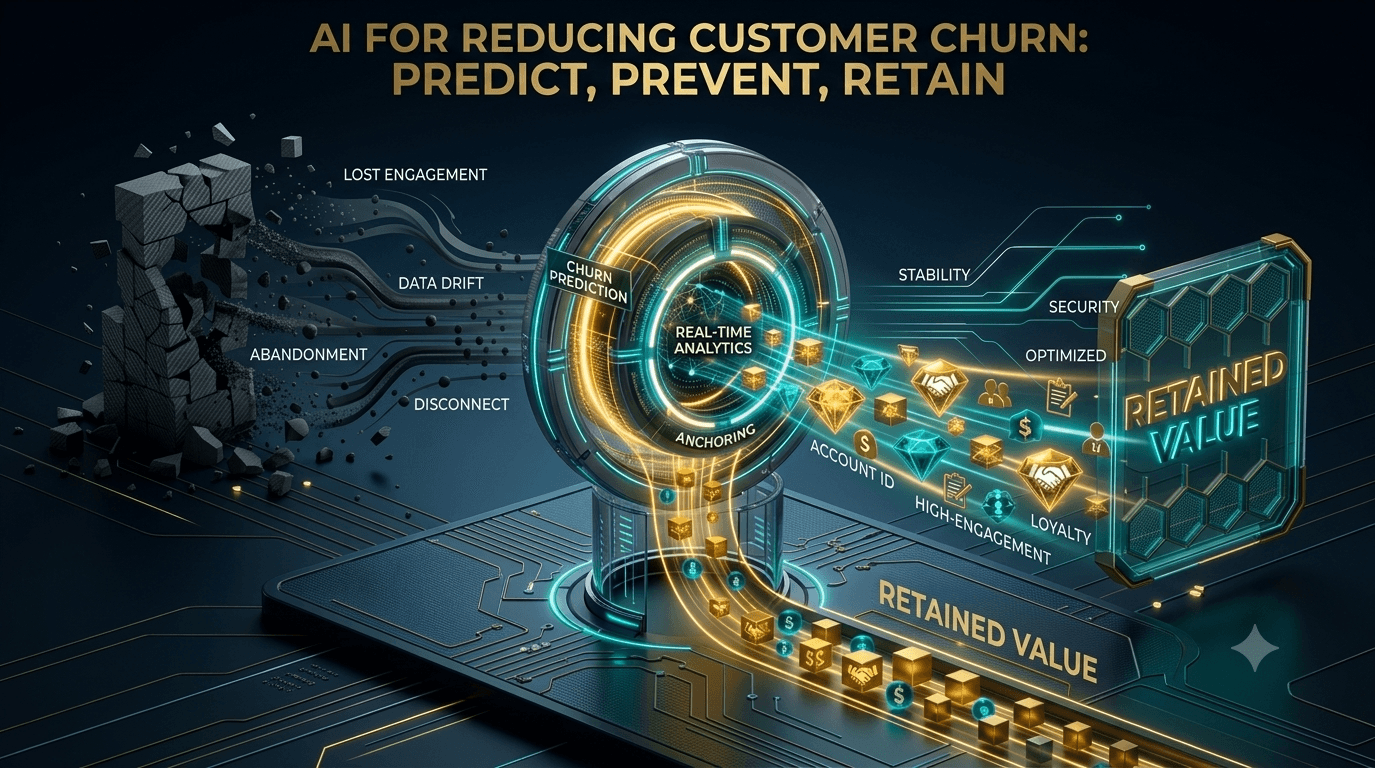
AI for Reducing Customer Churn
Imagine your favorite café remembering your order and noticing when you stop visiting. Now imagine doing that for thousands or even millions of customers. That is the power of AI for reducing customer churn.
Customer churn often goes unnoticed until it impacts revenue. Businesses invest heavily in acquiring customers, but without strong retention strategies, growth becomes unstable. This guide explains how AI helps predict churn, prevent it, and build long-term customer loyalty.
What Is Customer Churn and Why It Matters
Customer churn is the percentage of users who stop using a product or service over time. It is often called the silent killer of growth because it slowly reduces revenue without immediate visibility.
Think of your business as a bucket. You keep adding new customers, but if existing ones keep leaving, the bucket never fills.
Reducing churn is essential because:
- Retaining customers costs less than acquiring new ones
- Loyal users generate higher lifetime value
- Stable retention leads to predictable revenue
From Reactive to Predictive: The Role of AI
Traditional churn analysis looks backward. It explains why customers left after they are already gone. AI changes this by acting like a “check engine light” for your business.
Using machine learning and predictive analytics, AI identifies early warning signs before churn happens. It analyzes patterns across thousands of data points and predicts which customers are at risk.
This shift from reactive to proactive decision-making is what makes AI so valuable.
How AI Identifies At-Risk Customers
AI-powered churn prediction relies on multiple layers of data working together:
1. Behavioral Signals
AI tracks how customers interact with your product:
- Login frequency and activity levels
- Feature usage and engagement trends
- Email opens and website visits
A sudden drop in activity often signals declining interest.
2. Customer Sentiment
Using Natural Language Processing, AI can analyze support tickets, chat messages, and feedback to detect frustration or dissatisfaction.
For example, repeated complaints or negative tone in conversations can indicate churn risk.
3. Time-Based Patterns
AI understands timing and urgency. Recent and frequent changes in behavior carry more weight than older actions. A customer who suddenly reduces usage is more likely to churn than one with slow, steady engagement.
4. Predictive Modeling
AI uses historical data to build models that calculate a churn probability score.
This score updates in real time, helping teams focus on high-risk and high-value customers first.
Turning Insights into Action
Prediction alone is not enough. The real value comes from acting on these insights.
AI enables businesses to respond with targeted retention strategies:
- Personalized Offers: Tailored discounts or recommendations based on user preferences
- Proactive Support: Reaching out before issues escalate
- Guided Engagement: Sending tutorials or tips to improve product usage
For example, if a user struggles with a feature, AI can trigger a helpful guide or prompt a support agent to assist them.
Real-World Example
Consider a subscription-based digital platform. Some users gradually stop logging in and reduce engagement.
With AI in place:
- The system detects early signs of disengagement
- It predicts which users are likely to cancel
- It recommends personalized content or incentives
This proactive approach helps retain users and improve overall satisfaction.
Key Benefits of AI in Customer Retention
- Early Detection: Identify churn risks before they become problems
- Improved Customer Experience: Address issues proactively
- Personalized Engagement: Deliver relevant communication
- Higher Retention Rates: Keep valuable customers longer
- Better Business Insights: Understand why customers leave
AI-powered customer retention strategies transform scattered data into meaningful action.
Challenges to Consider
While AI is powerful, successful implementation requires careful planning:
- Data Quality: Inaccurate data leads to poor predictions
- Integration Effort: Systems must connect with CRM and analytics tools
- Transparency: Some AI models may be difficult to interpret
The solution is to maintain clean data and use tools that provide clear insights.
Best Practices for Implementation
To get the most out of AI for reducing customer churn:
- Define clear retention goals and success metrics
- Build a strong data foundation across all touchpoints
- Continuously train and refine AI models
- Align teams across marketing, sales, and customer support
- Test and optimize retention strategies regularly
A structured approach ensures long-term success.
The Human Element: AI as an Enabler
AI does not replace human interaction. It enhances it. By handling data analysis and prediction, AI allows teams to focus on meaningful customer relationships.
Instead of guessing who might leave, teams can engage with the right customers at the right time, with the right message.
The Future of Churn Reduction
AI is moving beyond prediction into full personalization. Future systems will not only identify at-risk customers but also recommend the exact action needed to retain them.
Imagine knowing not just who to contact, but what to say and when to say it. That level of precision will redefine customer experience.
Conclusion
AI for reducing customer churn is transforming how businesses approach customer retention. By combining predictive insights, behavioral analysis, and real-time action, companies can move from reacting to preventing churn.
In a competitive market, keeping customers is just as important as acquiring them. Businesses that embrace AI-driven retention strategies will build stronger relationships and achieve sustainable growth.
What are your thoughts on using AI to improve customer loyalty?