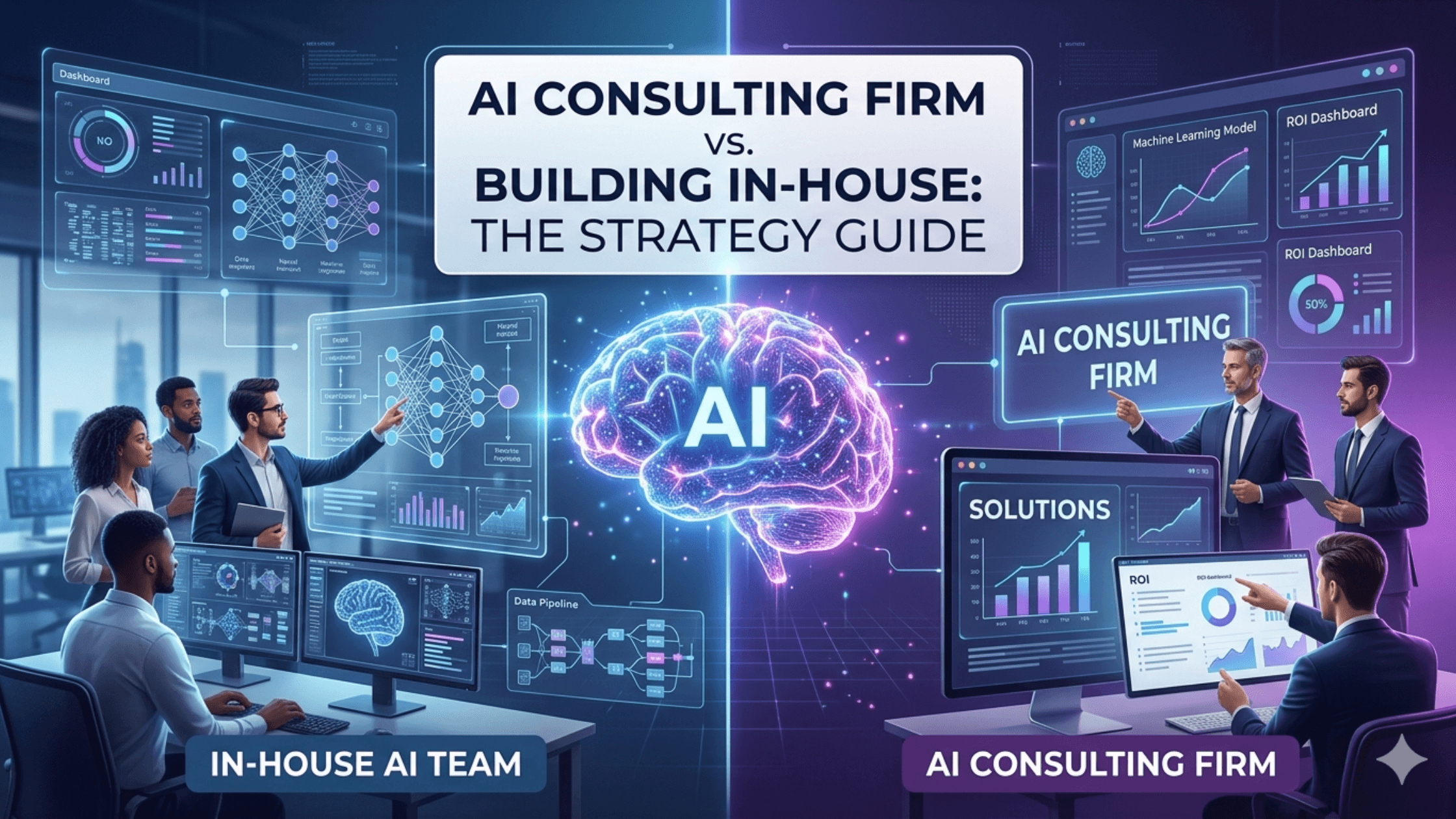
Artificial intelligence has quickly moved from an experimental technology to a core business capability. From customer service chatbots to predictive analytics and automated decision systems, companies across industries are investing heavily in AI.
But once an organization decides to adopt AI, a major strategic question appears. Should you hire an AI consulting firm, or should you build your own in-house AI team?
This decision affects everything from development speed and costs to intellectual property and long term innovation. In this guide, we will explore the advantages, challenges, and strategic considerations of both approaches to help businesses choose the right path.
Understanding the Two Approaches to AI Development
Before comparing them, it helps to understand what each model involves.
AI Consulting Firm
An AI consulting firm is an external partner that designs, develops, and deploys AI solutions for businesses. These firms usually have teams of specialists including data scientists, machine learning engineers, AI architects, and product strategists.
Hiring a consulting firm is similar to bringing in experienced architects and engineers to design a complex building. Instead of assembling a team from scratch, companies gain immediate access to expertise and proven workflows.
Consulting firms typically work on projects such as:
- Building AI powered applications
- Developing machine learning models
- Implementing automation tools
- Designing AI infrastructure and strategy
They often serve multiple industries, which allows them to bring diverse insights and proven solutions.
Building an In-House AI Team
Building AI in-house means creating a dedicated internal team responsible for developing and maintaining AI systems within the company.
An in-house AI team may include:
- Data scientists
- Machine learning engineers
- AI product managers
- Data engineers
- MLOps specialists
This approach gives companies full ownership over the development process and allows teams to deeply understand the organization’s data, workflows, and strategic goals.
Speed to Market: The Biggest Difference
One of the most noticeable differences between the two approaches is speed.
AI consulting firms are built for rapid deployment. Their teams already have experience, tools, and development pipelines in place. Many consulting projects can begin within weeks.
Building an in-house AI team, however, takes much longer. Companies must recruit specialized talent, set up data infrastructure, and establish workflows. In many cases, this process can take several months before real development begins.
For organizations that need fast experimentation or quick product launches, consulting firms often provide a significant speed advantage.
Access to Specialized Expertise
Artificial intelligence is not a single technology. It includes many specialized fields such as natural language processing, computer vision, predictive analytics, and recommendation systems.
AI consulting firms often employ experts who work across many projects and industries. This experience allows them to identify best practices and avoid common technical mistakes.
For example, a consulting team that has implemented recommendation engines for multiple retailers can apply those lessons to new clients much faster.
In contrast, in-house teams develop expertise gradually. While they may eventually become deeply knowledgeable about the company’s specific domain, building that level of expertise takes time.
Cost Considerations
Cost is one of the most common factors companies evaluate when comparing an AI consulting firm vs building in-house.
AI Consulting Firm Costs
Advantages:
- No long term hiring commitments
- Lower recruitment and training costs
- Ability to scale resources based on project needs
Challenges:
- Higher hourly or project based fees
- Costs may increase if projects expand or continue long term
Consulting firms are often cost effective for pilot projects, short term initiatives, or experimental AI deployments.
In-House AI Team Costs
Advantages:
- Long term investment in internal knowledge
- Potentially lower cost for ongoing AI development
Challenges:
- High upfront hiring costs
- Salaries for highly specialized AI engineers
- Infrastructure requirements such as GPUs, data pipelines, and cloud computing resources
In simple terms, consulting firms may be more affordable for short term projects, while in-house teams can become more economical for continuous AI development.
Data Security and Intellectual Property
Data plays a central role in artificial intelligence. For many companies, protecting proprietary data and algorithms is a top priority.
Building AI in-house provides complete control over sensitive data, model training, and product design. Organizations retain full ownership of their code, datasets, and machine learning models.
For industries such as healthcare, finance, or government, this level of control can be essential for regulatory compliance and security.
Working with consulting firms usually involves sharing some level of internal data. While reputable firms maintain strong security practices, some organizations prefer to minimize external access to sensitive information.
Long Term Innovation and Business Strategy
Another key consideration is how AI fits into the company’s overall strategy.
When AI Is Core to the Business
If AI is central to the company’s product or competitive advantage, building an in-house team may be the best choice.
Examples include:
- A fintech company developing AI driven credit risk models
- A logistics firm optimizing delivery routes using machine learning
- A SaaS platform building AI powered product features
In these cases, internal expertise becomes a long term asset.
When AI Supports Existing Operations
If AI is primarily used to improve operations such as marketing analytics, customer service automation, or demand forecasting, hiring an AI consulting firm may be more practical.
Consultants can deliver solutions without requiring the company to build a full AI department.
The Hybrid Model: A Growing Strategy
Many organizations are now choosing a hybrid approach that combines both models.
In this strategy:
- AI consultants design and implement the initial system
- Internal teams gradually take over maintenance and improvements
Some companies also maintain a small internal AI leadership team while outsourcing specialized development tasks.
This model allows businesses to move quickly while still building internal knowledge over time.
How to Decide: Three Questions to Ask
Before choosing between an AI consulting firm and building an in-house team, companies should consider three key questions.
1. Is AI a core product or a supporting tool? If AI is central to your business offering, building internal expertise is often essential. 2. How quickly do you need results? If speed is critical and competitors are moving quickly, consulting firms can accelerate development. 3. Does your organization have the infrastructure to support AI talent? AI engineers require specialized tools, computing resources, and data pipelines. If these systems are not in place, consultants may provide a faster starting point.
Final Thoughts
The choice between an AI consulting firm vs building in-house is not about which option is universally better. It is about selecting the strategy that aligns with your company’s goals, resources, and timeline.
Consulting firms offer rapid deployment, specialized expertise, and flexibility. In-house teams provide deeper integration, stronger control over intellectual property, and long term innovation.
For many businesses, the most effective approach is to combine both strategies. Start with external expertise to accelerate development, then gradually build internal capabilities as AI becomes a core part of the organization.
As artificial intelligence continues to reshape industries, the companies that succeed will be those that not only adopt AI but also choose the right structure to support it.